Edrxbox: a simpler way to write `dim-*' functions in Maxima
- 1. What is this?
- 2. Try it!
- 3. The core: edrxbox.lisp
- 4. The examples: edrxbox-examples.lisp
- 4.1. Verbatimbox
- 4.2. Antideriv
- 4.3. Underbrace
- 4.4. Displaying edrxboxes
(TODO: reuse parts of my outdated page about maxima-vbtbox.html.)
(First version of this page: 2025dec13. Announcement.)
1. What is this?
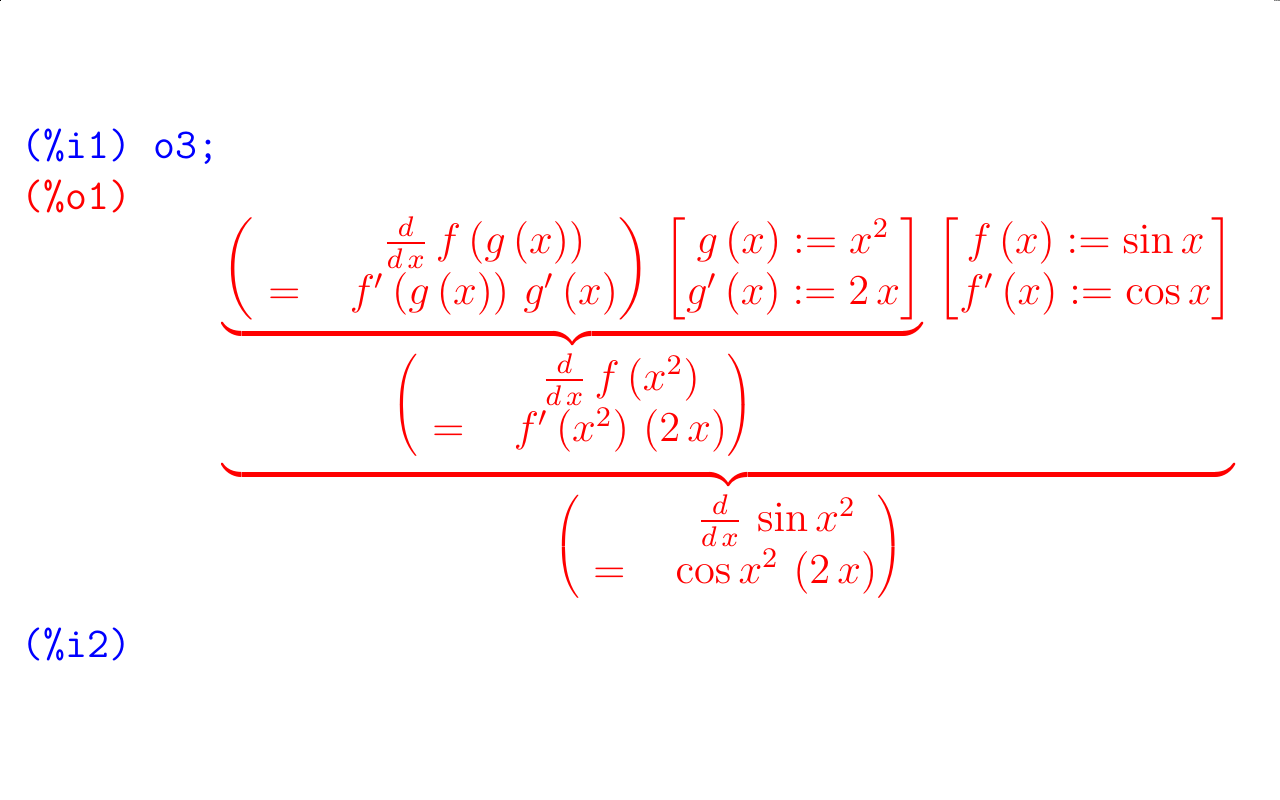
In Maxima we can define operations that are displayed and LaTeXed in special ways. Making `underbrace(a,b)' be LaTeXed as `\underbrace{a}_{b}', as in the first screenshot below, is very easy; making it be displayed as in the second screenshot, as something that looks vaguely like a fraction but in which the baseline is the baseline of the top object, is VERY hard.
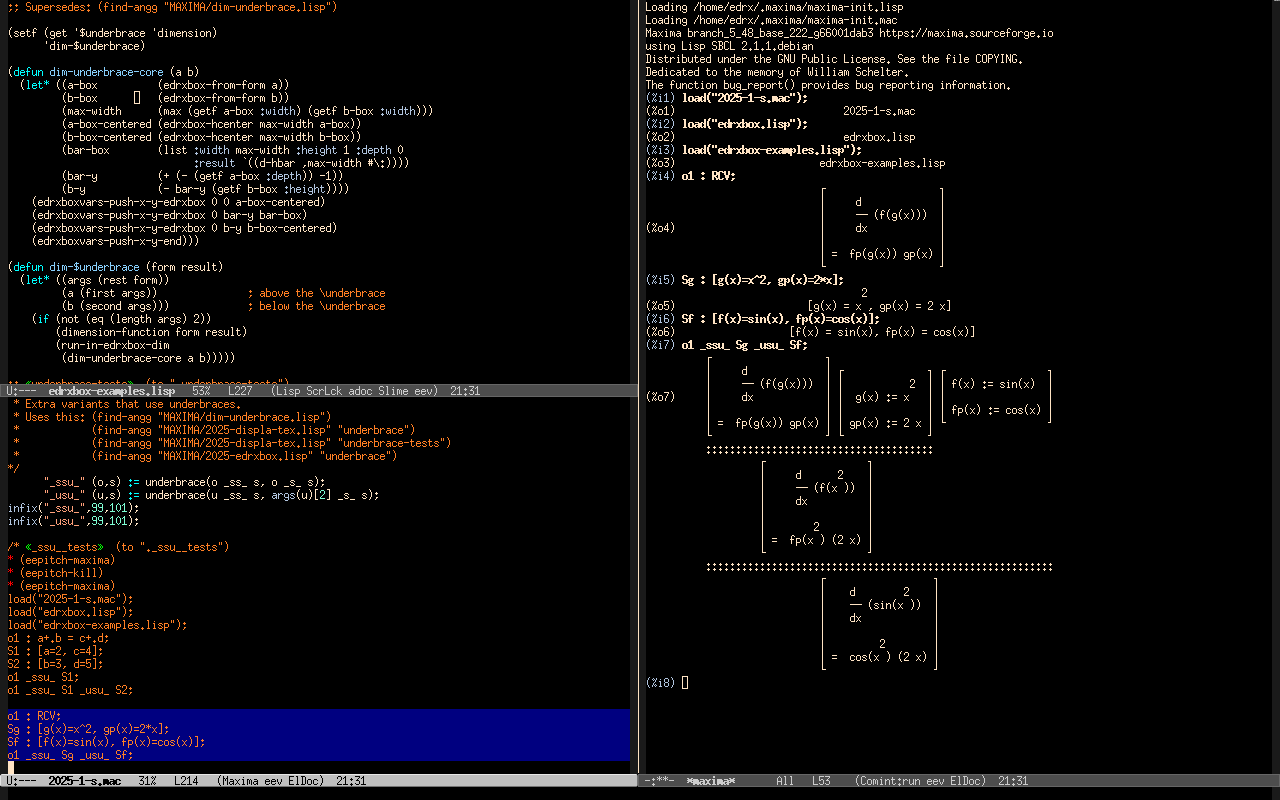
Look at this bug report, for example - it took me ages to understand dim-antideriv.lisp, and more ages to find a one-line fix that fixed its behavior in most cases. We need something better, like another way to write display functions... and I think that this is a step in the right direction.
2. Try it!
If you have eev installed and activated - and Maxima, of course - you can try edrxbox by downloading its two files, edrxbox.lisp and edrxbox-examples.lisp, with something like these commands...
* (eepitch-shell) * (eepitch-kill) * (eepitch-shell) cd /tmp/ wget -N https://anggtwu.net/bad-foundations/edrxbox.lisp wget -N https://anggtwu.net/bad-foundations/edrxbox-examples.lisp # (find-fline "/tmp/edrxbox.lisp") # (find-fline "/tmp/edrxbox-examples.lisp") |
...and then run the tests and examples in its test blocks. The next sections explain what its tests and examples do.
3. The core: edrxbox.lisp
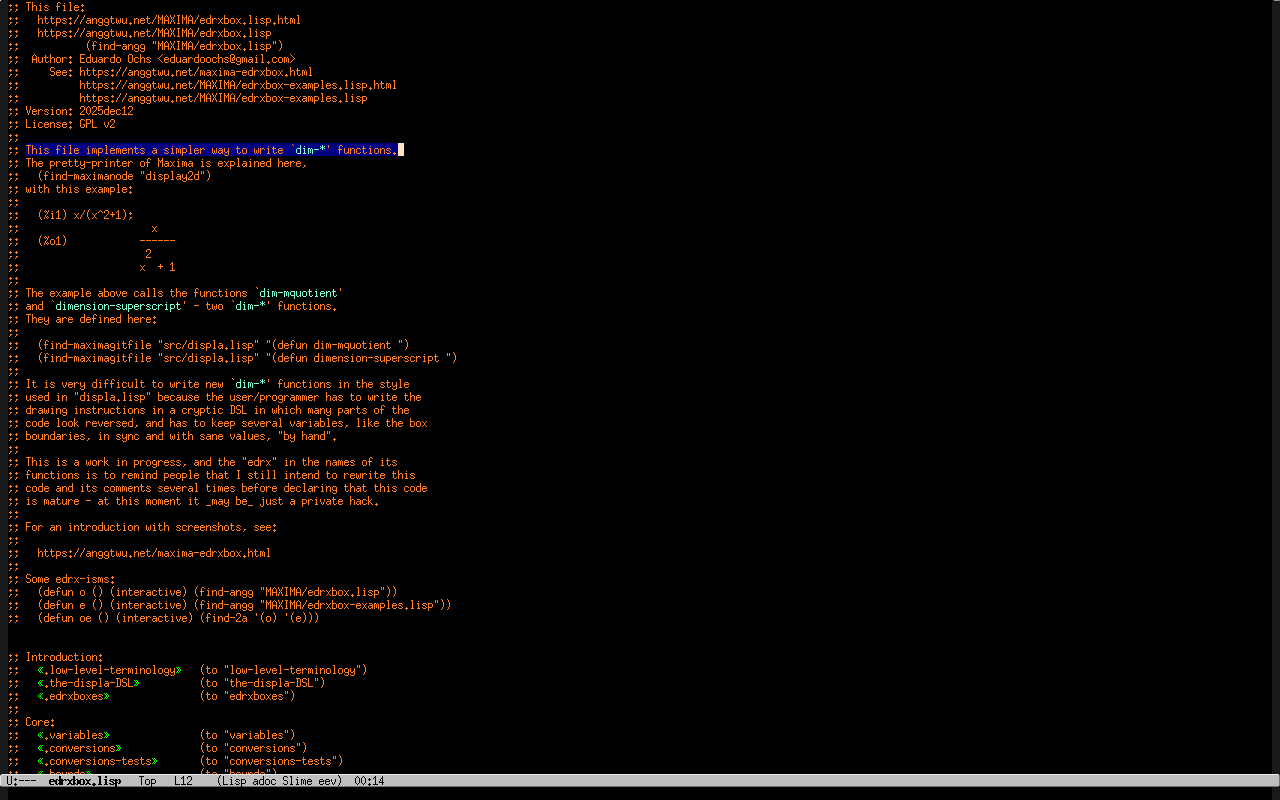
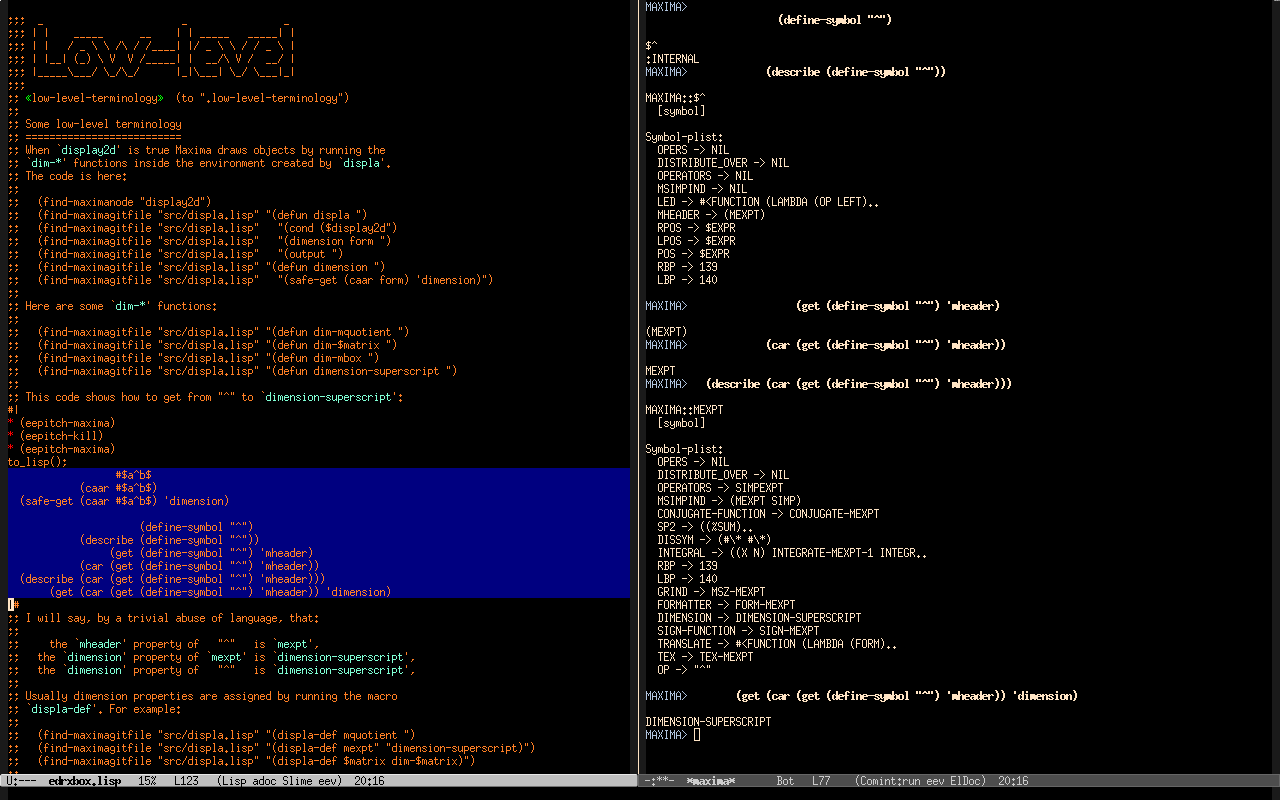
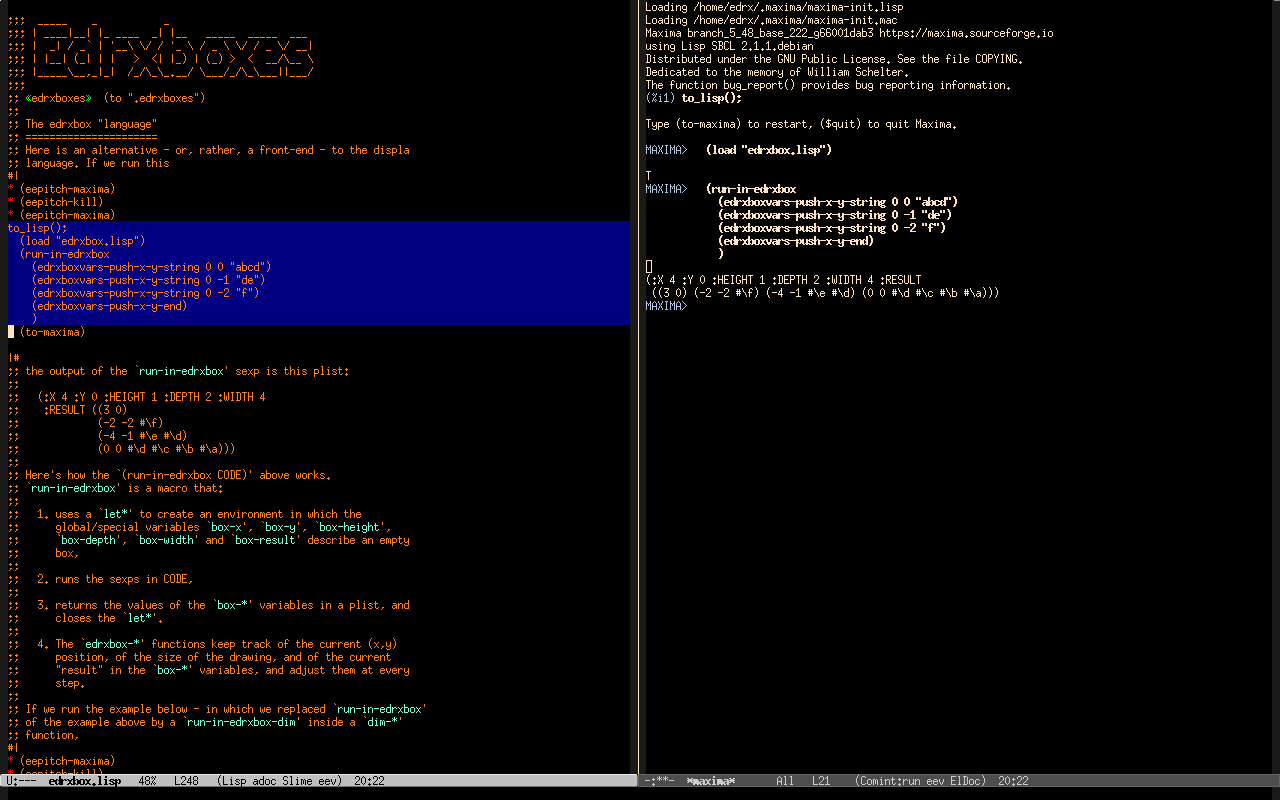
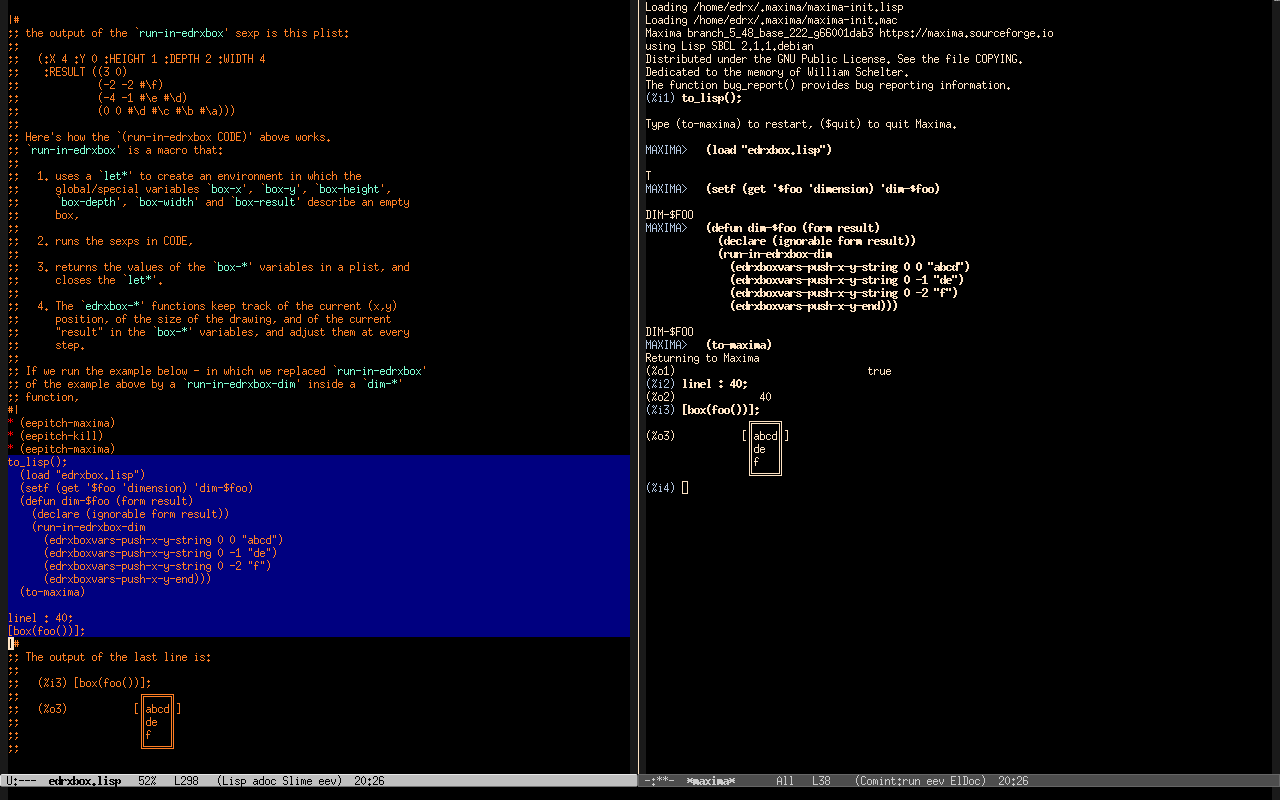
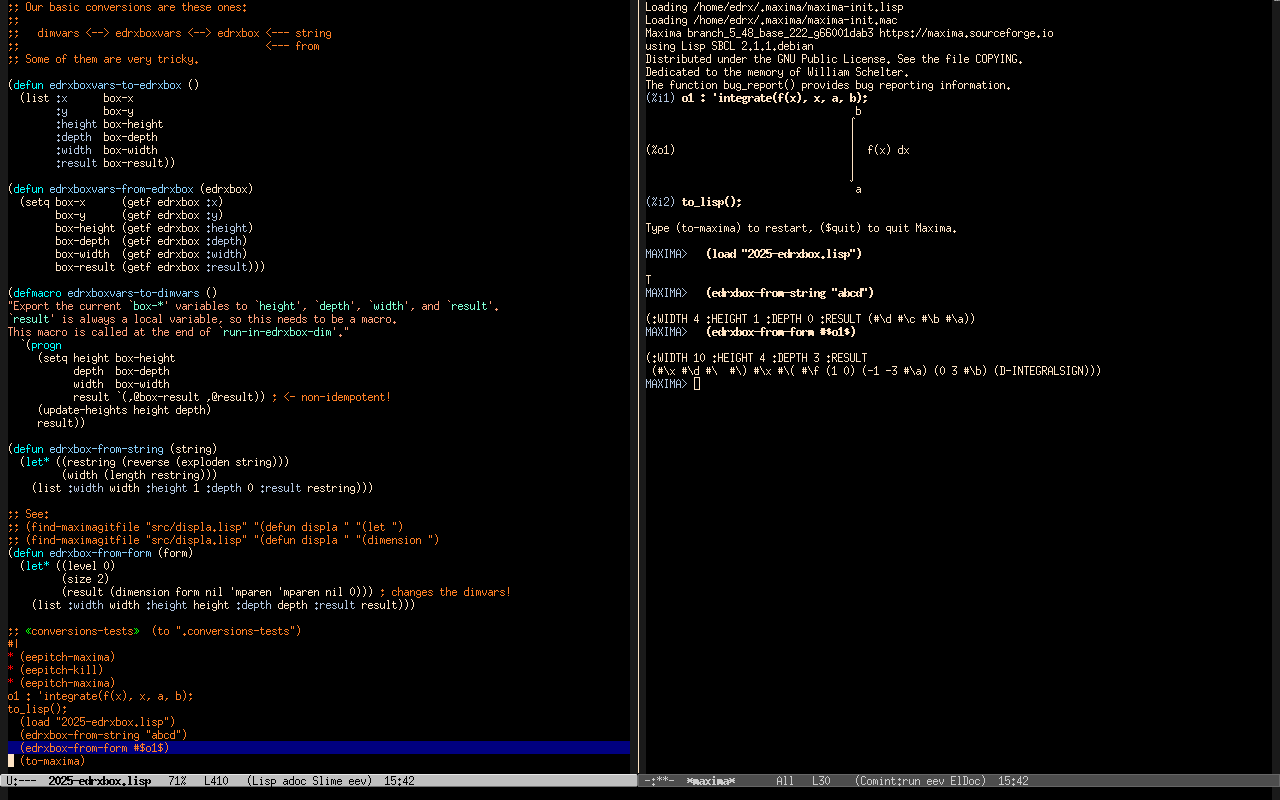
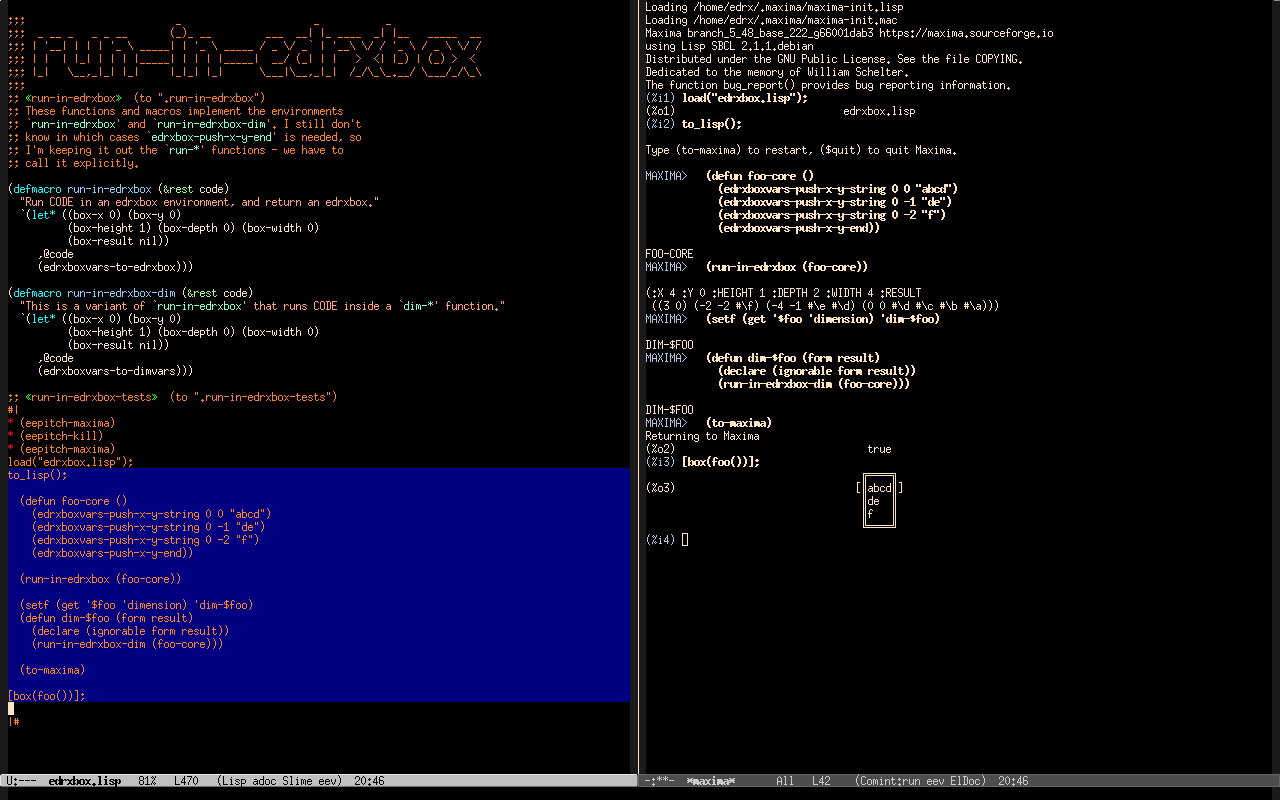
The file edrxbox.lisp has lots of explanations, and it has only a handful of (boring) test blocks that demonstrate low-level things... these ones, starting on the second screenshot:
It also has lots of links to displm.lisp and displa.lisp. To make them work in Emacs you need a `code-c-d' like this one:
(code-c-d "maximagit" "~/bigsrc/maxima/") |
In Emacs they will point to specific lines in the Maxima source, like in this screenshot:
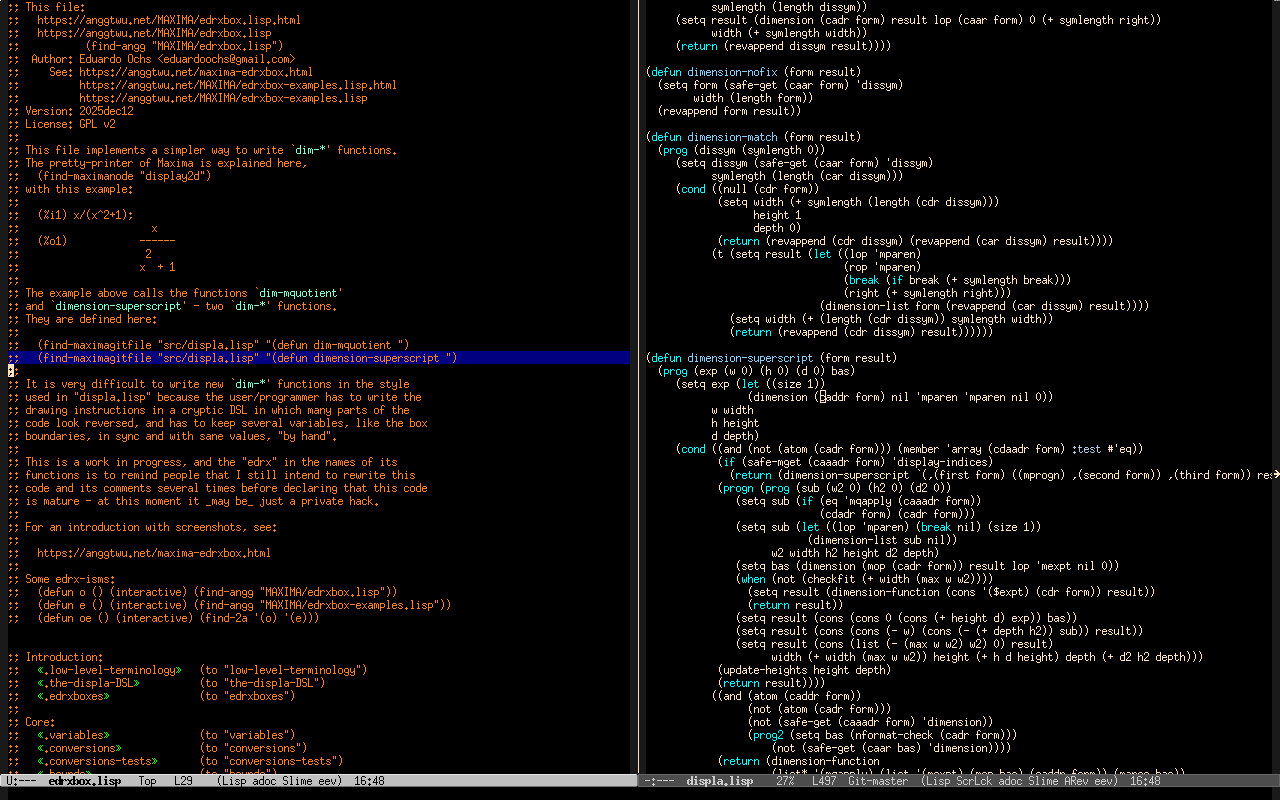
but in the htmlized version of edrxbox.lisp their pos-spec-lists don't work, and the links point to the top of the files in the git repository.
4. The examples: edrxbox-examples.lisp
The file edrxbox-examples.lisp is much more interesting... it has these examples:
4.1. Verbatimbox
Verbatimbox is used by lisptree:
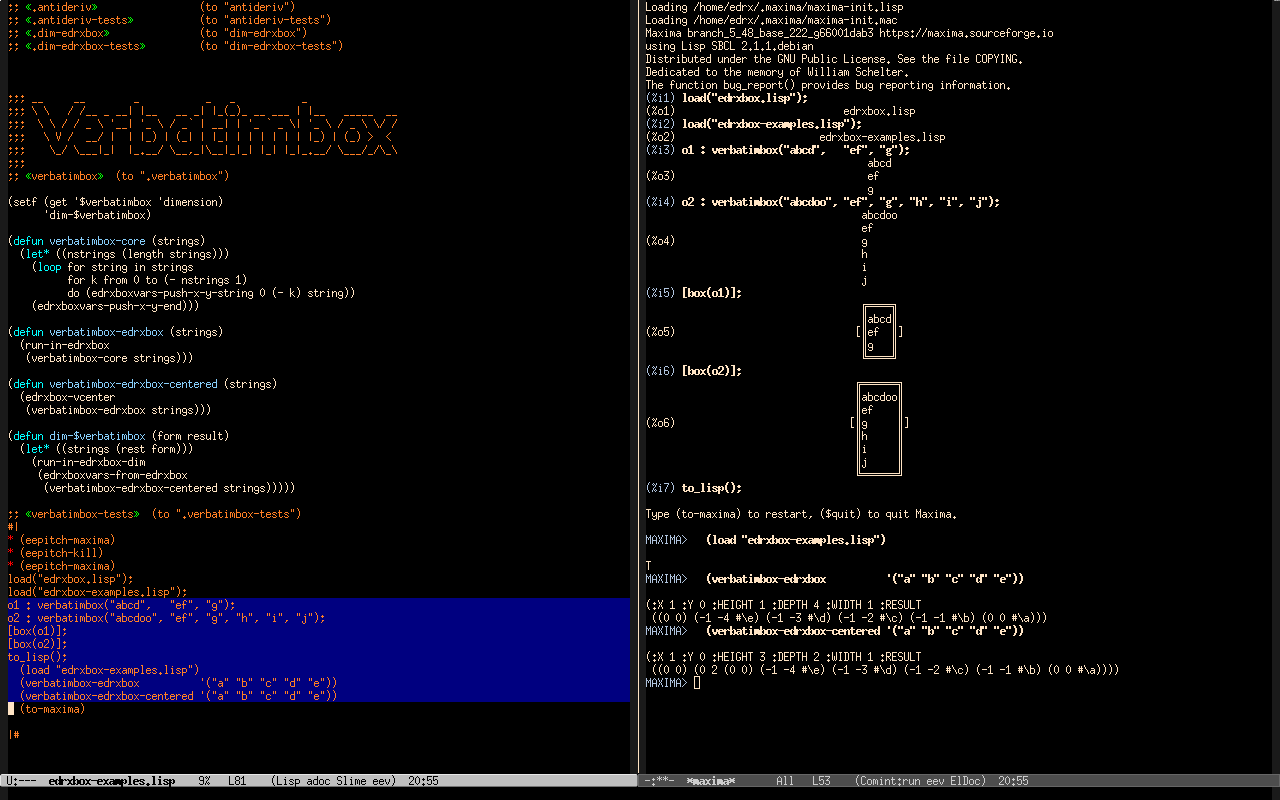
Note what was needed to center the drawing around the baseline - just a call to `edrxbox-vcenter', that added a "move" command to the drawing instructions.
4.2. Antideriv
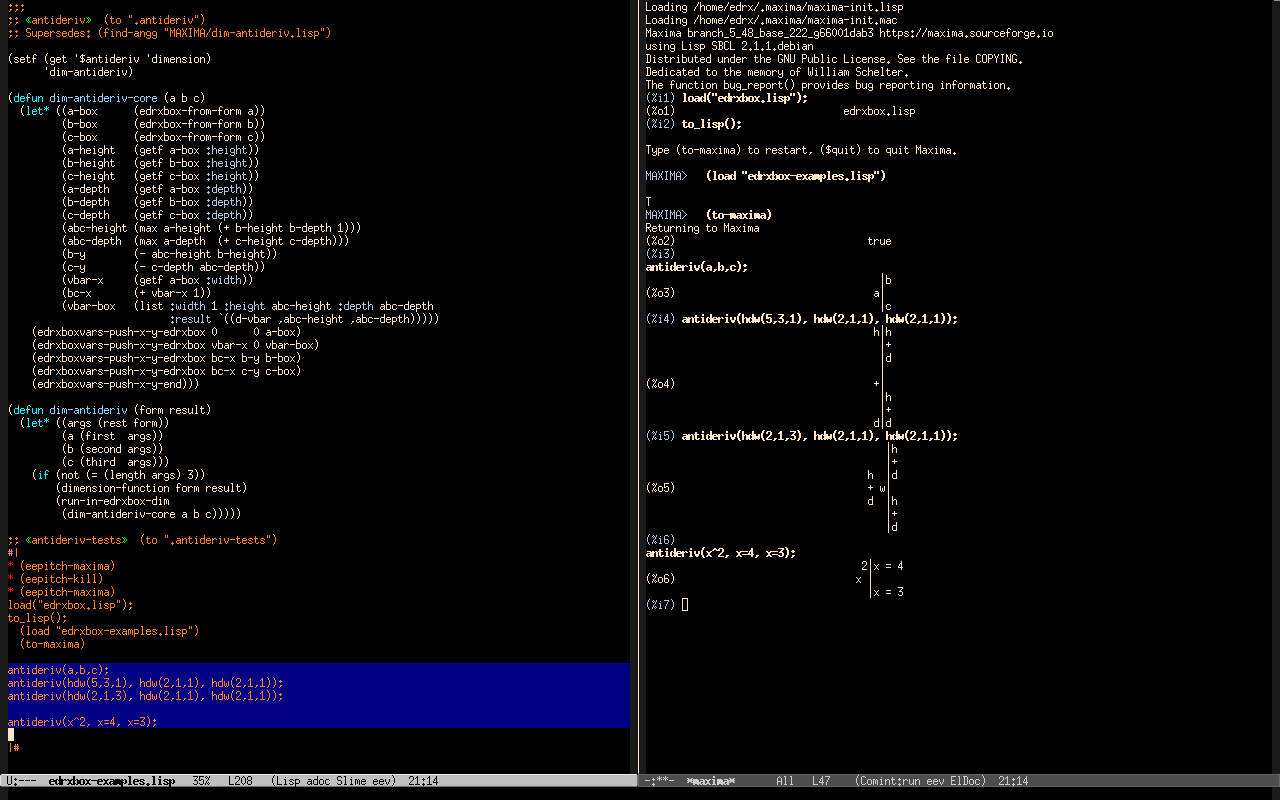
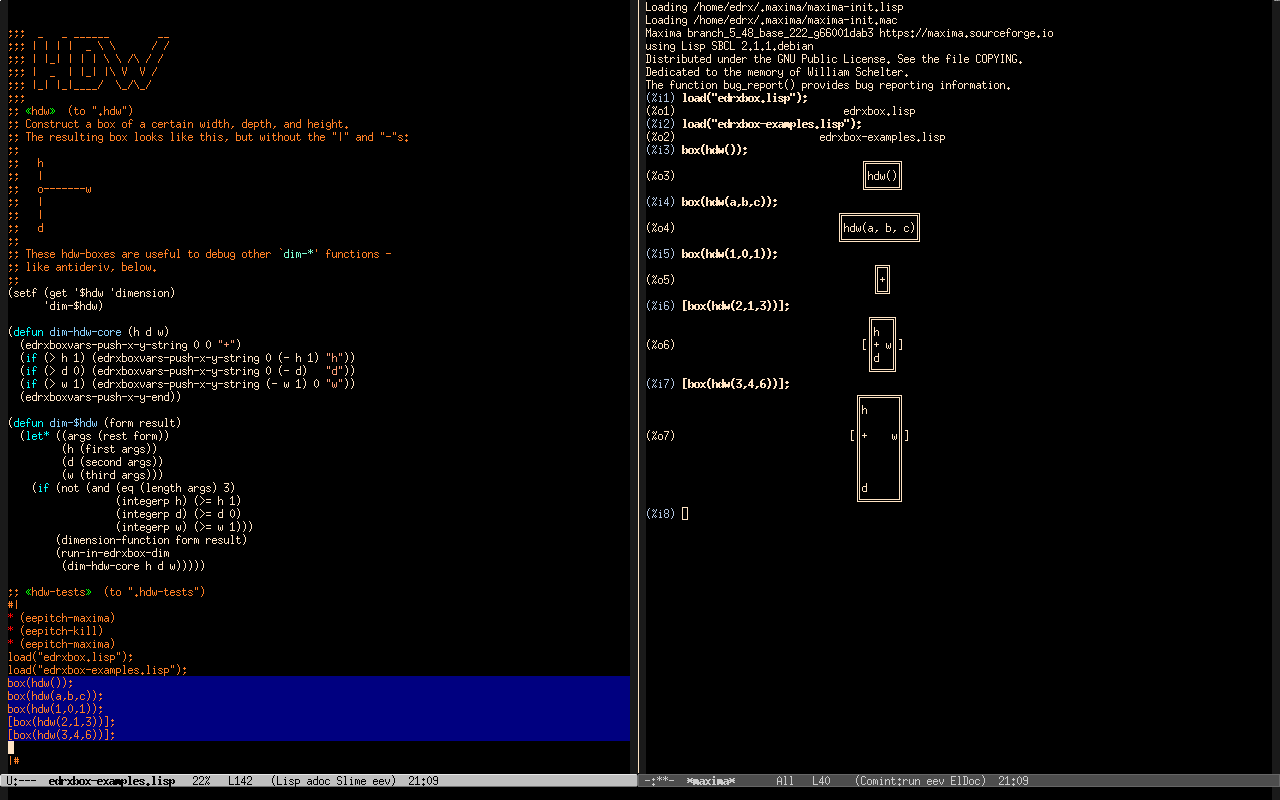
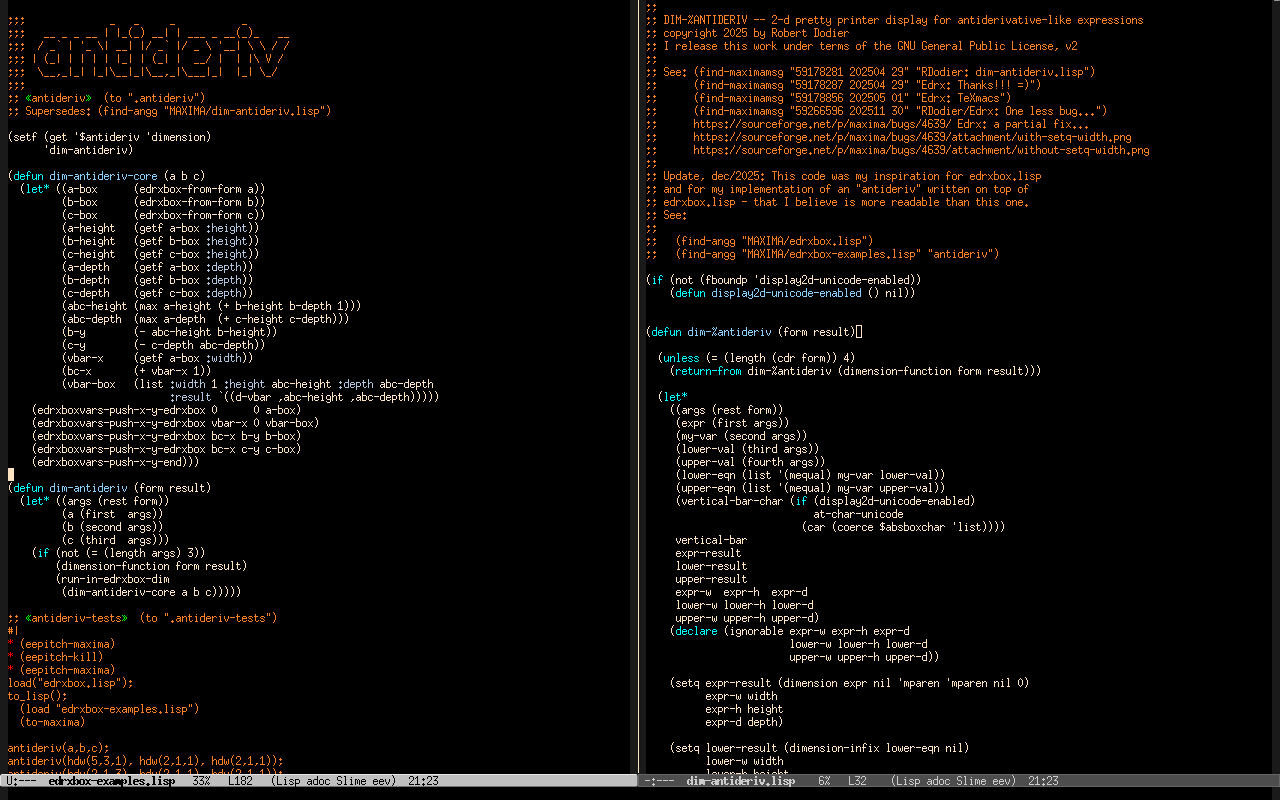
The first two screenshots below show `antideriv' and `hdw'. `hdw' creates a box with a certain height, depth, and width; I use it mostly to debug `dim-*' functions. The third screenshot below shows a comparison between the `antideriv' written with edrxbox and its antecessor, dim-antideriv.lisp:
4.3. Underbrace
The next screenshot shows `underbrace' - note how the horizontal centering was done by just calling `edrxbox-hcenter' - and a demo that uses my substitution operator, `_s_', and these variants of it.
The second screenshot shows how these underbraces are LaTeXed - see the introduction.
4.4. Displaying edrxboxes
Remember that in a previous section we saw a debugging function, `edrxbox-from-form', that displays the drawing instructions for a given Maxima object. Here is its screenshot again:
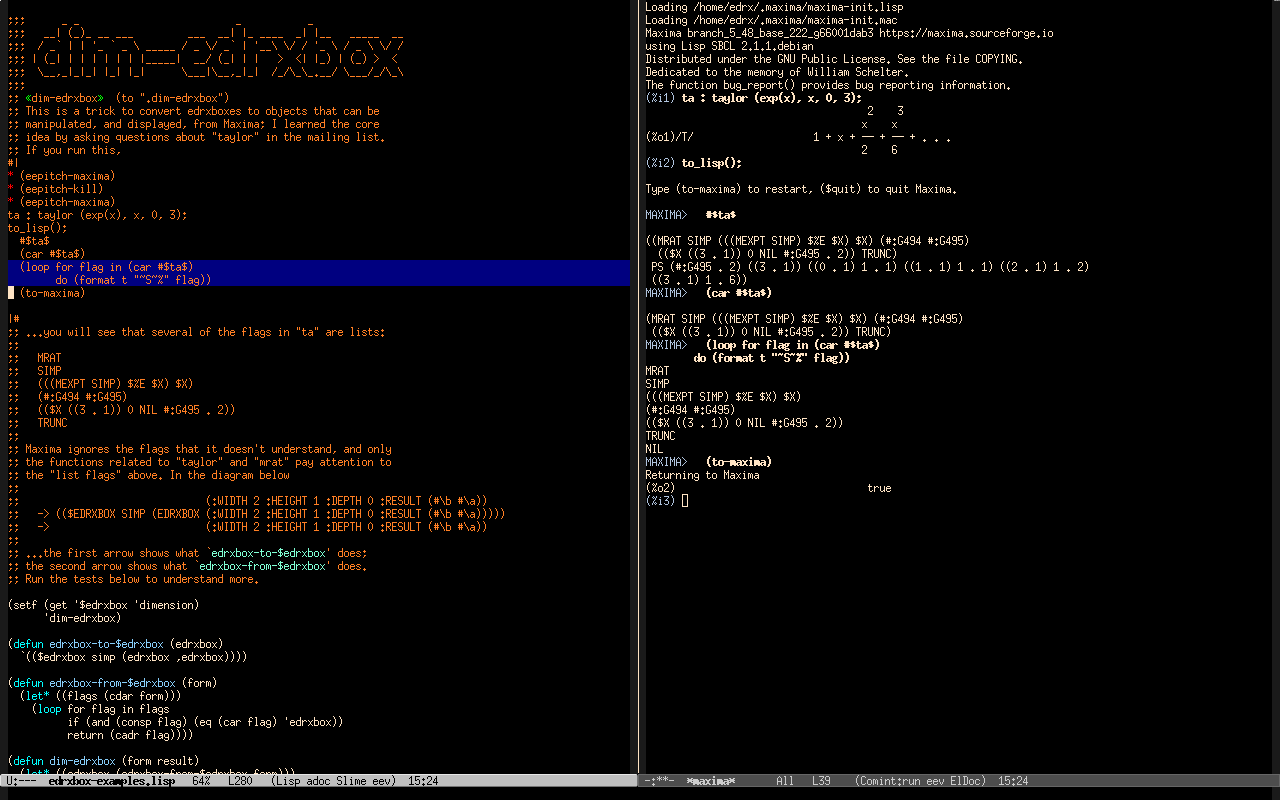
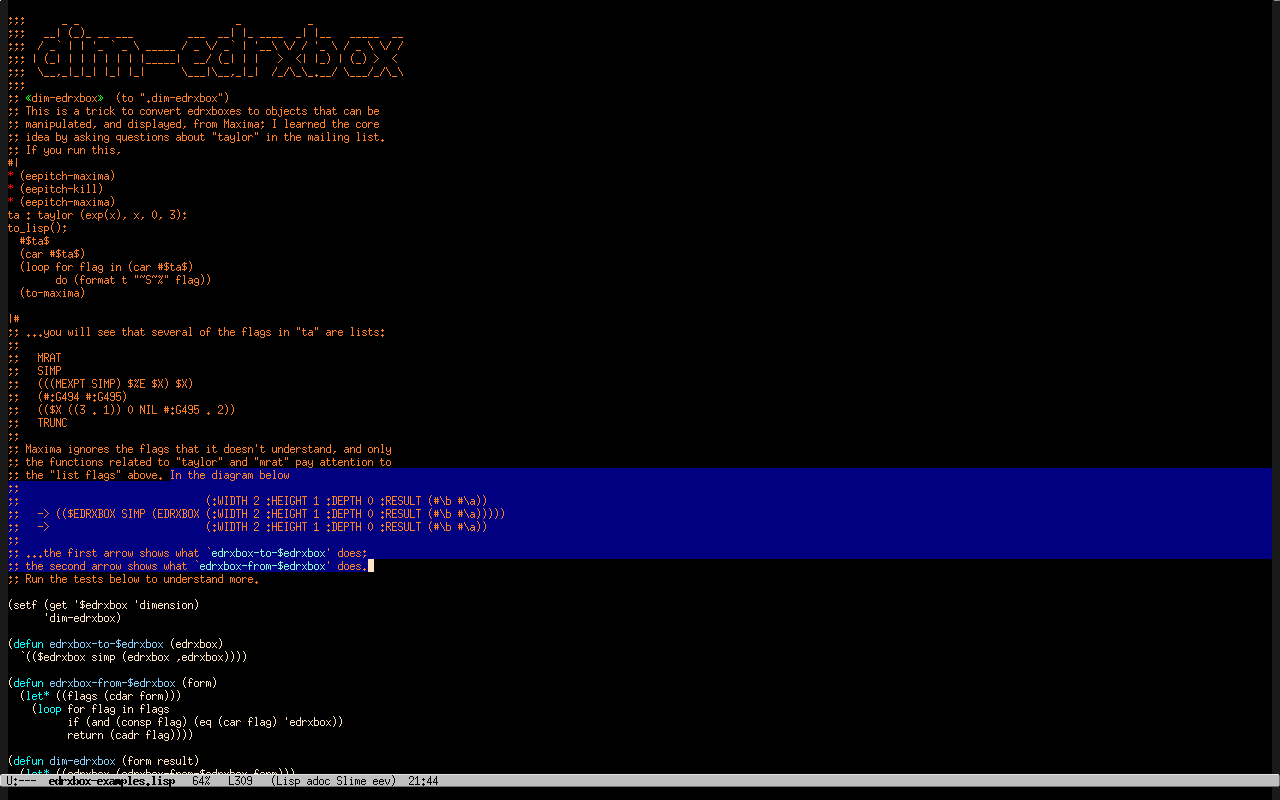
The next example is another debugging function, `edrxbox-display', that receives an edrxbox, converts its drawing instructions into a Maxima object - whose associated `dim-*' function is `dim-edrxbox' -, and makes Maxima display it. The conversion is explained in the first two screenshots below,
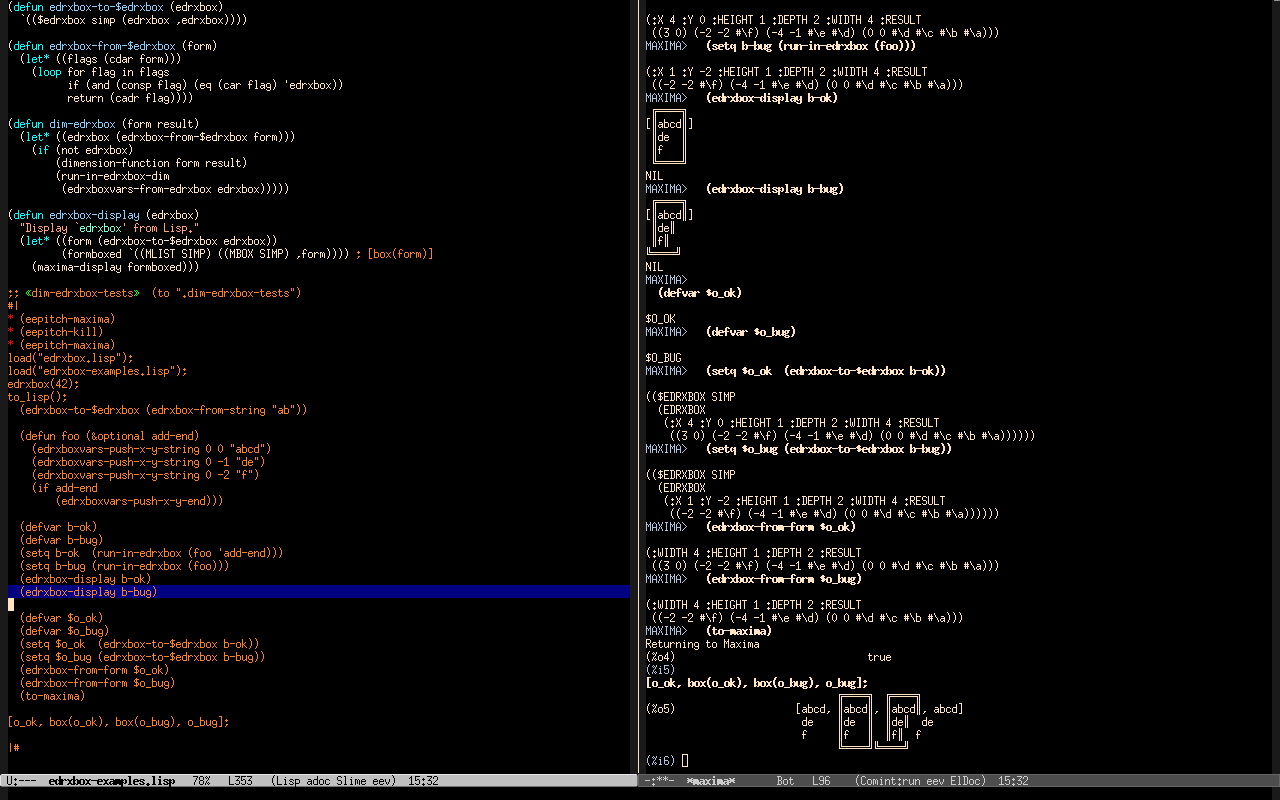
...and the third screenshot shows what can happen when we don't run `edrxboxvars-push-x-y-end' to move the current (x,y) position to the "right" ending place.
This is related one of my motivations for writing edrxbox.lisp, by the way... see this bug report, that describes a similar bug that took us months to fix, and the explanations in the beginning of edrxbox.lisp, that have this paragraph:
It is very difficult to write new `dim-*' functions in the style used in "displa.lisp" because the user/programmer has to write the drawing instructions in a cryptic DSL in which many parts of the code look reversed, and has to keep several variables, like the box boundaries, in sync and with sane values, "by hand".